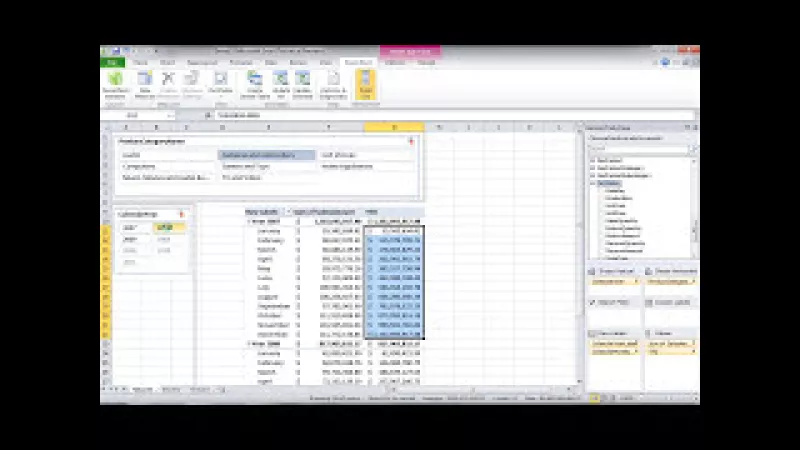
Knowledge videos Microsoft BI PowerPivot DAX Time calculations : YTD In this webcast you will see how to create a DAX calculation that returns the Year To Date value. Jeudi, 17 juillet 2014
Bi-kipedia SAP Analysis, Edition for MS Office "SAP Analysis, Edition for MS Office” is the new name of the Bex Analyzer product as part of the SAP Business Objects 4.0 release. This solution allows SAP Netweaver Business Warehouse users to perform analysis of BW data in Microsoft Excel and Microsoft Office (Powerpoint) Jeudi, 17 juillet 2014
Bi-kipedia SAP Analysis, Edition for OLAP Formerly known as SAP Business Objects Voyager, "SAP Analysis, edition for OLAP”, finally brings OLAP to Business Objects.It is a key deliverable of the SAP Business Objects 4.0 release and crucial in unlocking data residing in SAP BW InfoCubes.With this OLAP tool, key users can create analyses on multidimensional data by the use of a web interface. Jeudi, 17 juillet 2014
Bi-kipedia SAP Business Objects Dashboards SAP BusinessObjects Dashboards is the new name, in the SAP BusinessObjects 4.0 release, of SAP BO Xcelsius.It is a powerful dashboarding & visualization tool.Complex business data can be presented in an easy way with the use of interactive gauges, charts, sliders and widgets. Decision makers can browse through the data and test future scenarios with basic "what if” functionality. Jeudi, 17 juillet 2014
Bi-kipedia SAP BEX - SAP Business Explorer SAP BEX or SAP Business Explorer Analyzer is the Microsoft Excel add-in reporting tool used to query and work with data from the SAP Business Information Warehouse or shorter the BW (Business Warehouse). Jeudi, 17 juillet 2014
Bi-kipedia SMART - Specific, Measurable, Achievable, Realistic, Timely Defining goals you want to reach is easier said than done. Checking goals against the SMART criteria can help in assessing whether the defined goals can be realised.SMART is an acronym for - Specific- Measurable- Achievable- Realistic- Timely. Jeudi, 17 juillet 2014
Bi-kipedia Star schemas Two "dimensional modeling” techniques are generally used for modeling the data structures within a data warehouse context.These are the "star schema” and "snowflake schema” techniques. Both find their roots within the Kimball dimensional modeling techniques.A star schema is the preferred technique within the Kimball approach.Properties of star schemas :are easier to navigateimproves query performanceeases the "browsing” of dimensionsismore widely used andthe dimensions are fully de-normalized. Jeudi, 17 juillet 2014
Bi-kipedia Common dimensions When a data model is defined within a data warehouse context it is important to properly define the dimensions. In this way the same dimension can easily be re-used within another context. Common dimensions are standard dimensions, which can be shared among various data models or star schemas. Jeudi, 17 juillet 2014
Bi-kipedia Unstructured data Unstructured data are non- structured data (see also "Structured data”). People are using unstructured data every day; examples of unstructured data are emails, webpages, documents, images and spreadsheets.This kind of data does not have a structured format, it has no conceptual or data type definition. Jeudi, 17 juillet 2014
Bi-kipedia Common dimensions When a data model is defined within a data warehouse context it is important to properly define the dimensions. In this way the same dimension can easily be re-used within another context. Common dimensions are standard dimensions, which can be shared among various data models or star schemas. Jeudi, 17 juillet 2014